The fresh fact: Beijing weighs closing foreign access to its frontier
On July 7, 2026 Reuters reported that China's Ministry of Commerce, over the preceding weeks, had held meetings with Alibaba (Qwen), ByteDance (Doubao) and Z.ai (GLM) to weigh limits on foreign access to their most advanced AI models — including those not yet released. On the table, according to three people not authorized to speak publicly: a ban on public release of frontier models, domestic-only usage, treating AI IP theft as a national security offense, filters on foreign investors.
It's worth saying up front what this news isn't. It isn't a draft regulation. It has no timeline. Any measures could apply only to models not yet released. The ministries involved have not commented. This is journalistic sourcing, not regulation.
It's still worth saying, because it arrives a few weeks after a mirror move from the other side of the Pacific. And the symmetry is the fact — not who is right.
The US mirror: two weeks in June
On June 9, Anthropic publicly launched Claude Fable 5 and Claude Mythos 5. On June 12, US Commerce Secretary Howard Lutnick sent a letter to CEO Dario Amodei directing Anthropic to suspend access to both models for any non-US citizen anywhere in the world, including foreign nationals working physically on US soil. Legal basis: export control powers and national security. Stated trigger: a reported jailbreak that would have bypassed the models' guardrails.
The reopening was gradual, not a switch. On June 26 Lutnick granted partial access to Fable and Mythos for US companies and federal agencies "with appropriate safeguards." On June 30 the Commerce Department lifted the controls entirely. On July 1 access went global again. Anthropic committed to proactively detect and mitigate security risks on its models, collaborate with the government on standards for future models, and inform the government of malicious activity.
Two weeks in total. But the precedent stands: it's the first time the US government has used export control powers to globally suspend an AI model from a US company. Not a dead letter — an operational precedent.
What "weights as state assets" means
Before 2026, frontier model weights moved like any other software product: released, downloaded, integrated into pipelines. Within a few weeks, both superpowers began treating them as something else — a strategic asset to control, not a product to ship. If this becomes the new baseline, the open-weight "download-and-use across borders" era will have been a phase, not a doctrine.
The convergence is what gives weight to both moves taken together. Alone, Lutnick's directive on Fable and Mythos is an episode; alone, the reported leak on China's Commerce Ministry is a reported leak. Overlapped three weeks apart, they trace an axis. And the axis changes how one should think about frontier models over the next few quarters.
Why it matters even if you never touch a Chinese model
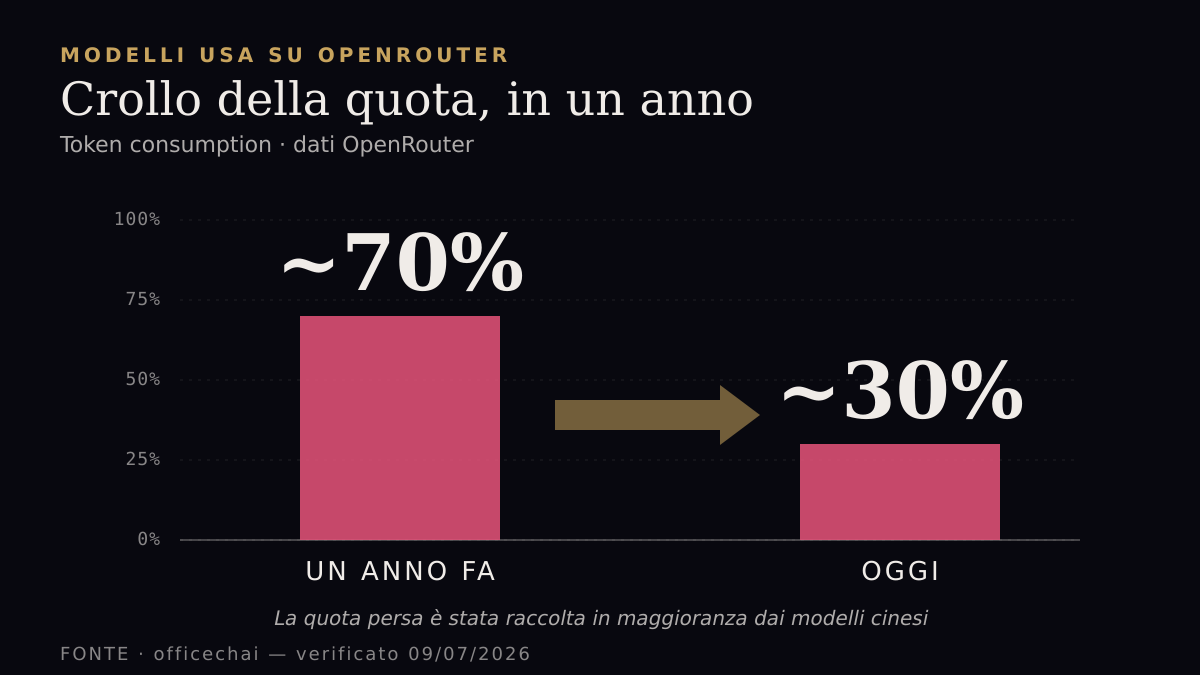
The past year's adoption numbers explain why the Chinese move would matter globally, not only inside the Chinese perimeter. On OpenRouter, the routing platform to 400+ models used by developers worldwide, US models went from about 70% to about 30% of token consumption over one year. Most of that share was picked up by Chinese models.
The RAND report "U.S.-China Competition for Artificial Intelligence Markets" (January 2026), which tracked web traffic across 135 countries from April 2024 to May 2025, measured the global share of Chinese models rising from roughly 3% to roughly 13% in the two months after DeepSeek R1's launch. Penetration above 10% in thirty countries, above 20% in eleven. Chinese model pricing sits at 1/6 to 1/4 of US rivals.
This is not theory. These are companies in production.
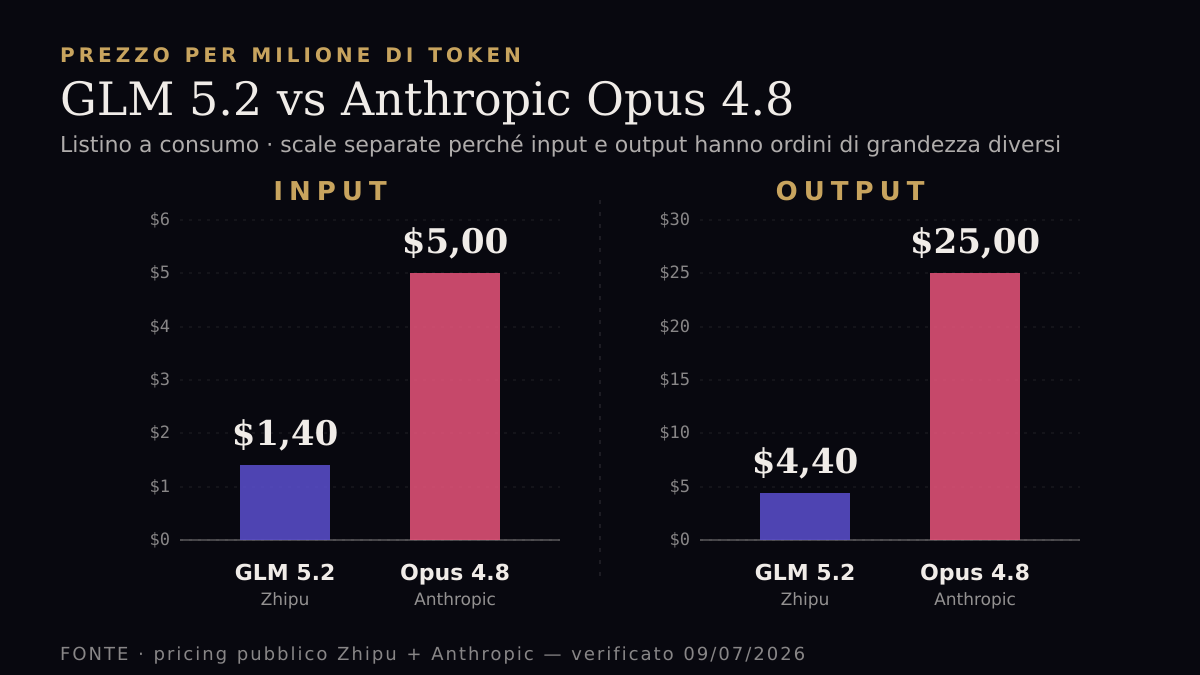
Coinbase. CEO Brian Armstrong stated that default engineer routing has been shifted to GLM 5.2 (Zhipu) and Kimi K2.7 Code (Moonshot) via an internal LLM gateway. Result: about 50% reduction in internal AI spend, with token usage climbing. Pricing is the main variable — GLM 5.2 runs at about $1.40 / M input and $4.40 / M output, versus $5 / $25 for Anthropic Opus 4.8. On SWE-bench Pro, GLM 5.2 hits 62.1%, above GPT-5.5 at 58.6%. An honest note of context: Armstrong has not publicly discussed how Coinbase handles the compliance risk of routing US financial workloads through Chinese-origin models. The question remains open.
Shopify. A merchant data extraction pipeline previously on GPT-5, replaced with a multi-agent self-hosted system on Alibaba's Qwen 3, with a sharp reduction in per-unit cost. Fine-tuning of Qwen3-32B embedded inside Shopify Flow for natural-language automation.
Airbnb. CEO Brian Chesky reported "heavy" Qwen use in the service bot. Stated reason: performance, fast response times, low cost.
The mechanism keeping US lab prices in check is the credible existence of Chinese alternatives at drastically lower cost. It's the "price ceiling." If Beijing shuts the tap on future models, the ceiling rises — not by theory, by negotiation math.
The paradox: released weights don't come back
Here's the structural constraint that resizes any closure announcement. A released open-weight model — Qwen 2, Qwen 3, DeepSeek V3, R1, Kimi K2, GLM-4.6, LongCat-2.0 — is effectively unrecoverable once out. Thousands of mirrors, forks, quantizations, distillations. Any future restriction, from either side, applies operationally only to models that have not yet shipped.
On the same June 30 that the US Commerce Department was lifting the controls on Fable and Mythos, Meituan published LongCat-2.0 open-source on Hugging Face: 1.6 trillion parameters in a Mixture-of-Experts architecture, tuned for agentic coding tasks, trained — per Meituan — entirely on a cluster of 50,000 domestic Chinese GPU chips. Training budget: over 35 trillion tokens. The closest prior data point, DeepSeek V4-pro, used domestic chips only for inference; pre-training stayed on US hardware. Meituan claims to be the first to have completed the full process — pre-training and inference — at trillion-parameter scale on a domestic cluster.
There's no evidence the June 30 release was planned as a response to the US day. It's a narratively powerful coincidence, not a coordinated event. But it says something concrete: the training stack without US hardware is no longer a promise, it's a public model.
What to watch in the coming months
On August 2, 2026 the enforcement powers of the European Commission under the EU AI Act kick in for GPAI model providers. From that date the Commission can request documentation, run evaluations, impose fines up to €15M or 3% of global turnover. It's the third axis of the same dynamic — treating models as regulated infrastructure, not as a neutral product. We'll come back to that separately.
The things to watch are the same for both superpowers: whether concrete draft regulations emerge in China or a new iteration of the US directive; whether a tiered regime on frontier models is formalized (light filings for base tools, security reviews for strong models, domestic lockdown for frontier); whether the price ceiling starts moving up on US labs' rate cards. The tone of statements matters less than the drafts.
For those building on these models today — creators, founders, small teams paying pay-as-you-go APIs — the operational question isn't "what will happen in six months." It is: which weights do I already have inside my infrastructure, and what would change if the next model in that family stopped shipping across borders. Look at what's already downloaded, before looking at what will be downloaded.