In the third episode of the second season of HBO's Silicon Valley, which aired on 26 April 2015, a fictional investor walks in and roughly says this: if you have revenue, they ask how much — and it's never enough; but if you have no revenue, you can say you're pre-revenue, and then you're worth more. It's a character bit, not a benchmark; in the same scene the same character claims that Amazon has lost money every quarter for the last twenty years, and that's factually wrong — Amazon posted its first full-year profit in 2003. But the fictional line touches something that is well-documented off-screen: the perceived value of an entity and its measurable value are two different quantities, often decoupled by orders of magnitude.
This article walks through the mechanism with verified cases — four collapses and two exceptions that confirm the rule — and tries to answer a question anyone building something public today has some skin in: when inflated perception meets the measurement, what happens to the past?
The mechanism, in two sentences
In experimental psychology the foundation is the halo effect. In 1977 Richard Nisbett and Timothy Wilson published in the Journal of Personality and Social Psychology an experiment with 118 students who were shown the same Belgian instructor in two different versions — one warm, one cold. Those who saw the warm version rated even unrelated traits like accent and physical appearance as appealing; those who saw the cold version rated the same traits as irritating. A single global perception contaminates dimensions that have nothing to do with it. The mechanism is bidirectional: things rise together on the way up, and fall together on the way down.
In economic theory the foundation is what Robert Shiller calls narrative economics — the 2019 book (Princeton University Press) and the earlier NBER working paper 23075 (2017). Shared stories about a company, an industry or a founder move valuations long before the fundamentals confirm the story; they keep moving them until a measurable fact puts the story to the test. Before the fact, perception can inflate without limit. After it, the measurement narrows the space brutally.
The moment when the number arrives is the interesting part.
The truck rolling down the hill
The most tangible example of the pattern is recent, and it has a visual scene that stands in for the whole mechanism. Nikola Corporation, an EV and hydrogen-truck startup founded by Trevor Milton, reached a market cap of over thirty billion dollars in June 2020 after the SPAC merger that took it to Wall Street. It was not producing a single functional truck at scale. Back in 2018 the company had released a promotional video of the Nikola One in which the truck appeared to be driving under its own power on a road. Roughly a year and a half later, the Hindenburg Research report of 10 September 2020, titled Nikola: How to Parlay An Ocean of Lies Into a Partnership With the Largest Auto OEM in America, revealed that the truck had been towed to the top of a hill and left to roll down under gravity. No engine, no propulsion, just camera angle.
The company's former chief engineer confirmed that the Nikola One was a non-functional prototype. Milton stepped down as executive chairman on 21 September 2020. In October 2022 a federal jury convicted him on one count of securities fraud and two counts of wire fraud; in December 2023 he was sentenced to four years in federal prison and a one-million-dollar fine.
Nikola is the most illustrative case because the "moment of measurement" is a physical fact — not an earnings call, not a filing, but a truck without an engine coasting down a hill. Measurable reality enters an environment that until then was living on perception alone, and from there perception does not gradually rebalance — it collapses quickly and rewrites the past backward.
Six weeks from the S-1 to the withdrawal
The second case has a nearly cinematic timeline. WeWork filed its S-1 for the IPO on 14 August 2019, with an implied valuation of about $47 billion inherited from a January 2019 SoftBank round. It was the first public document in which the numbers were required to appear. Out of it came conflicts of interest (the founder, Adam Neumann, had sold the "We" trademarks to the company for $5.9 million), a governance structure concentrated on the founder, structural operating losses and a business model that looked fragile once exposed to public scrutiny. Six weeks later to the day, on 30 September 2019, the S-1 was withdrawn. Neumann was removed as CEO. The valuation discussed in private markets dropped below ten billion. On 6 November 2023, the company — by then a penny stock — filed for Chapter 11 in the New Jersey bankruptcy court.
The detail worth isolating is the trigger. WeWork did not collapse because some external event hit it. It collapsed because the S-1 itself required the exposure of data that had until then been sitting in the private sphere. The $47B valuation was held up by a story that didn't need to be reconciled with the numbers — until the regulator forced it to.
Snap: a debut and a CFO who leaves
The third case is more prosaic but shows the same physics. Snap Inc. went public on 2 March 2017 at $17 per share, opened at $24 and closed the first trading day around $24.50, with a market cap of about $31 billion. The first public earnings, in May 2017, missed expectations and the stock shed roughly a quarter of its value within minutes. On 10 July 2017 the stock closed below the IPO price for the first time, at $16.99. In January 2019, after the surprise resignation of CFO Tim Stone after just eight months in the role, the stock dropped 13% in a single day. Market capitalization was below $8 billion — less than a quarter of the value assigned to it at debut less than two years earlier. Not one fact, but a sequence spread over time: earnings, executive exits, recurring revenue misses. Same pattern — inflated narrative, then contact with the measurement — on a scale of months instead of weeks.
The personal case: from billionaire to zero in months
The fourth collapse moves the mechanism from corporate to personal scale, and it's the part of the piece that matters most to anyone building public reputation. In 2014 and 2015 Elizabeth Holmes was named by Forbes the youngest and wealthiest self-made female billionaire in the United States, with a net worth estimated at around $4.5 billion on a Theranos valuation of about $9 billion. The most famous cover portrayed her in a black turtleneck with an intense stare — the iconography of the next Steve Jobs.
John Carreyrou's investigation for the Wall Street Journal in October 2015 showed that the technology did not work as Theranos had been claiming for years. In June 2016 Forbes revised its estimate of Holmes's personal net worth from $4.5 billion to zero. On 3 January 2022 Holmes was convicted by a federal jury on four counts: three of wire fraud against investors and one of conspiracy to commit the same fraud. In November 2022 she received a sentence of eleven years and three months in federal prison; her prison term began in May 2023.
The part that often gets missed, and that is actually the spine of the mechanism, is this: the same aesthetic and narrative choices that before 2015 were read as evidence of vision, after the investigation were reread as evidence of manipulation. The black turtleneck, the intense stare, the artificially deepened voice, the minimalist headquarters — none of that had materially changed. What had changed was the sign of the global judgment, and the sign of the global judgment recalibrated the sign of every individual element backward. Nisbett-Wilson 1977, outside the lab.

When the narrative was true (and the measurement confirmed it)
The risk, at this point, would be to walk out with the moral that perception is always a trick and measurement is always the moment of truth. It isn't. Two cases show the opposite, and one is so counterintuitive that it still feels exceptional more than a decade later.
The first is Amazon. The character bit in Silicon Valley that we paraphrased at the beginning contained an error, and also an intuition. The error is the number: Amazon didn't lose money for twenty years. The first full-year profit was 2003, roughly $35 million. The intuition, though, is in the mechanism itself: Jeff Bezos had chosen to reinvest every possible margin into warehouses, then Marketplace, then AWS — that is, into infrastructure that would generate cash at scale many years later. Reported net income was low or flat by design, not because the machine was burning cash. From 2018 onward Amazon's net income exceeded ten billion dollars a year; today the same reinvestment choice is a business-school case study.
The lesson isn't "those who fly always get vindicated later." Not everyone telling the same story survived. Amazon survived because the aggressive-reinvestment narrative had underneath it a real machine producing positive operating cash flow while net income was under pressure. Those who looked only at net income saw a Nikola-sized case. Those who looked at cash flow saw a thesis that would eventually be realized.
The second case — the counterintuitive one — is Facebook in 2012. Debut on 18 May at $38 per share for a $16 billion raise, a record for a tech company at the time. Within a few weeks the story flipped: the dominant narrative became mobile isn't working for Facebook, the fear being that mobile ad revenue would not offset the desktop decline; the stock fell from $38 to below $20, and in September 2012 hit a low below $18. It's the exact pattern you've seen at Snap, at WeWork, at Nikola: inflated perception at debut, first contact with measurement, collapse.
And then something different. Through 2013, Facebook's quarterlies showed that mobile ad revenue was growing faster than expected; the company began beating expectations quarter after quarter. On 31 July 2013 the stock reopened at $38.22, back to parity with the IPO price after fourteen months in the wilderness. Over the following decade it would cross $100, then $200, then $500. Anyone who in September 2012 was saying that Facebook was never going to make it on mobile now seems ridiculous — not because the argument was weak in isolation, but because the subsequent measurement rewrote the 2012 narrative backward, in a positive direction. Nisbett-Wilson halo effect, opposite direction from Theranos. Same physics, opposite outcome.
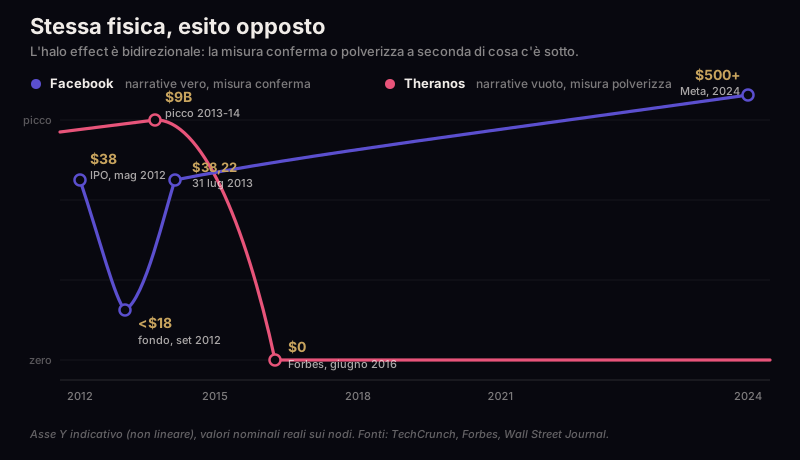
The rule, therefore, is not "perception always lies" and not "perception is always right." The rule is that perception is ambivalent, and measurement resolves the ambivalence. Which way it resolves depends on what's underneath.
It applies to you too
There's a reason this piece belongs to the insights section and not to the markets one. The same cognitive physics described by Nisbett and Wilson apply to personal, professional and brand reputation, and for anyone building something in public today, that's the part that carries the most weight.
A professional who becomes "the AI person" in their circle through well-written posts is building a positive halo around their profile. In the logic of the mechanism, for a while that halo contaminates even unrelated dimensions: the rates they can charge, the proposals they receive, credibility on adjacent topics. It lasts as long as no measurement arrives — a real project for a real client, a specific technical question in public, an operational challenge outside the content script. At that moment, just like Facebook 2012, the outcome depends on what's underneath: if the public profile matched the substance, the halo consolidates; if it matched a smaller substance, the halo tilts the other way and reads the earlier posts backward as thinner than they seemed.
There is nothing moralistic about this. It's how perception works. Anyone building a reputation without substance underneath is building their own future trap — not for ethical reasons, but because the moment of measurement will arrive, and the moment it arrives, the whole past will be reread through the new global judgment. Inflation isn't a free accelerant. It's a debt.
Recomposition
And then there's the part that doesn't get said enough. A collapsed personal reputation isn't final.
Adam Neumann, after the WeWork collapse and the avalanche of negative press (Hulu documentary included), received $350 million from Andreessen Horowitz on 15 August 2022 for a new residential real estate company called Flow — the largest single check that firm has ever written. Post-money valuation crossed the billion-dollar mark before operations had even started. An additional round in April 2025 pushed the valuation to $2.5 billion. Public narrative on Neumann isn't one of rehabilitation — it's still made of skepticism, documentaries, critiques. But real capital, in a concrete figure at a concrete moment, recomposed part of his operational reputation.
Why? Not "because he was good after all." Because the perception of the people who mattered for reopening the door for him — a small set of decision-makers with capital — was influenced by specific signals (access, a mixed but not zero commercial history, demonstrable narrative craft) that weighed more than the mass-public narrative. The physics are the same as the halo effect, but the relevant audience is narrow and the signal that shifts global judgment is different. Perception, in the personal as in the corporate case, recomposes according to the same laws by which it had collapsed.
This is the point where the piece connects to the Psychology satellite of the course in preparation, which addresses exactly these dynamics: how trust is built, how it's lost, how it's rebuilt, and who decides when perception reorients. There's no public date, and there are no magic formulas — there's a mechanism with rules, and the rules have practical consequences for anyone working in public today.
The honest verdict
Perceived value and real value are two different things. Perception can be orders of magnitude larger than measurable reality for a duration that can last years. But it's unstable in a particular way: when a measurement arrives, it doesn't rebalance to the middle — it moves entirely onto the measurement, and rewrites the past backward, including what looked solid.
With substance underneath — Amazon, Facebook 2012 — the measurement consolidates. Without it — Nikola, WeWork, Snap, Theranos — it pulverizes. The operating lesson for anyone building in public today is not "never inflate." It's: only inflate what you'll be able to hold when the number arrives. Because the number always arrives. It doesn't come when you decide, and it doesn't come in the form you imagine. But it comes.
Facts verified on 7 July 2026 against primary documents (Hindenburg report of 10 September 2020; Snap Investor Relations communications; a16z announcement Flow of 15 August 2022) and reference secondary sources (CNBC, Forbes, TechCrunch, TIME, DOJ Northern District of California, Wikipedia with cross-check). Nisbett and Wilson, 1977, "The halo effect: Evidence for unconscious alteration of judgments," Journal of Personality and Social Psychology, Vol. 35, No. 4. Robert J. Shiller, Narrative Economics, Princeton University Press, 2019. This content is produced with the assistance of AI systems and editorially reviewed by a human before publication.